
Healthcare Technology & Operations
Whether it’s a hospital, physician practice, imaging center, pharmacy, specialty clinic, or healthcare support organization, technology has become an essential part of delivering quality patient care and running efficient business operations. When systems fail, appointments are delayed, communication suffers, staff productivity declines, and patient satisfaction is affected.
Throughout my career, I’ve had the opportunity to work in healthcare from several different perspectives—including as a Hospital Engineer, an Operations Director for a national pharmacy organization, and an IT consultant supporting healthcare providers. Those experiences taught me that successful healthcare technology is about much more than installing equipment. It requires understanding how clinical workflows, business operations, security, compliance, and technology all work together.
My focus has always been helping organizations build reliable, secure, and well-documented technology environments that allow physicians, clinicians, and staff to focus on caring for patients instead of troubleshooting IT problems.
Areas of Experience
My healthcare technology experience includes:
- Enterprise network design and modernization
- UniFi and Cisco networking
- Secure remote access and VPN solutions
- 3CX business communications and VoIP
- Medical imaging and PACS environments
- Pharmacy and healthcare operations
- Vendor coordination and project management
- AI-assisted documentation and operational procedures
- Standard Operating Procedures (SOPs)
- Disaster recovery planning
- Backup and recovery strategies
- Endpoint security and monitoring
- Microsoft 365 and Google Workspace administration
- HIPAA-aware operational practices
- IT infrastructure assessments and modernization
Technology Should Support Patient Care
The best technology often goes unnoticed.
Reliable systems allow healthcare professionals to do their jobs without thinking about the infrastructure behind them. My goal is to build environments that reduce downtime, simplify support, improve security, and make technology easier to maintain as an organization grows.
I believe good IT starts with good planning. That means designing systems that are documented, standardized, monitored, and built with long-term reliability in mind—not simply solving today’s problem.
Security, Documentation, and Operational Resilience
Healthcare organizations face unique challenges when protecting sensitive information while maintaining efficient operations.
I build systems and documentation with security, accountability, and operational resilience in mind. Strong documentation, well-defined procedures, access controls, change management, disaster recovery planning, and proactive monitoring all help organizations manage risk and support their broader security and compliance objectives.
For organizations subject to HIPAA, these operational practices can support administrative, physical, and technical safeguards. While compliance depends on each organization’s policies, workforce practices, and implemented controls, well-designed infrastructure and accurate documentation are important parts of an overall compliance program.
Healthcare Technology Is Continuing to Evolve
Artificial intelligence, automation, business intelligence, cloud services, cybersecurity, and operational dashboards are changing how healthcare organizations manage both patient care and daily operations.
One of my goals is to help healthcare organizations understand these technologies in practical terms—identifying solutions that improve efficiency, reduce risk, and support better decision-making without adding unnecessary complexity.
Through this website, I’ll be sharing articles, implementation guides, real-world case studies, documentation standards, cybersecurity recommendations, AI use cases, and practical lessons learned from projects throughout my career.
-
Designing Resilient Healthcare Networks — Part 2
Designing Resilient Healthcare Networks — Part 2 A practical Cisco design that progresses from a single firewall and switch to dual internet, active/standby firewalls, independent Layer 3 switching, and wireless recovery paths for phones and computers. Cisco networks are often described as reliable because the equipment is proven and widely supported. That reputation is valuable,…
-
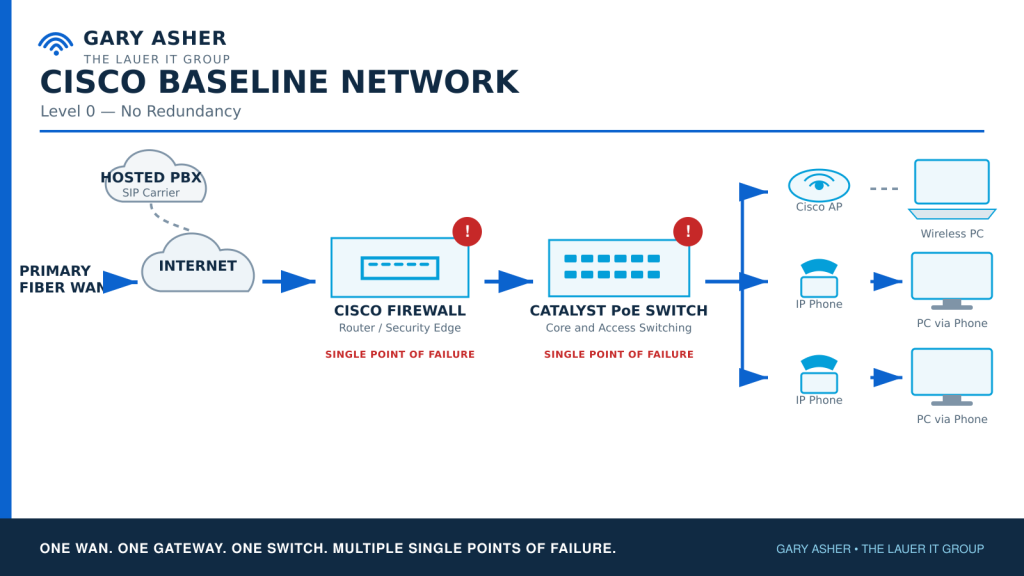
Designing Resilient Healthcare Networks — Part 1
Designing Resilient Healthcare Networks — Part 1 A practical framework for moving from single points of failure to dependable business continuity—without buying more technology than the organization can support. Healthcare organizations have little tolerance for technology failures. Phones, scheduling systems, medical imaging applications, cloud services, secure remote access, and everyday business communications may all depend…
-
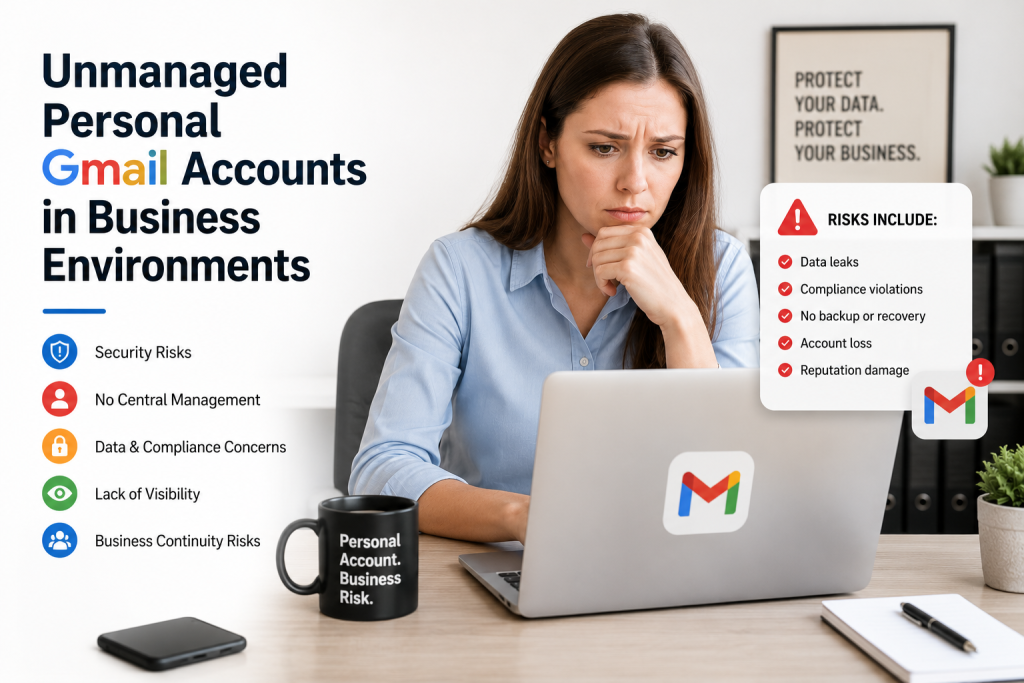
Unmanaged Personal Gmail Accounts in Business Environments
Personal Gmail and unmanaged Chrome profiles are convenient, but they can place company information outside company control. Email, files, saved passwords, bookmarks, extensions, and browser history may synchronize to accounts the organization cannot manage, monitor, retain, or disable. The solution is not necessarily to replace Microsoft 365 or move every business to Google Workspace. The…